Showing posts with label Book of Mormon Stories. Show all posts

Sunday, January 26, 2020

Lehi's Dream: What's In It For Me?

Over the past couple of years my church, The Church of Jesus Christ of Latter-Day Saints, has undergone some major shifts. The doctrine is the same, but some of the details about how we practice it have changed very much.  We've gone from a 3-hour block of Sunday meetings to a 2-hour block and began to shift responsibility for learning the gospel to the home.  Instead of going to church to learn God's word and plan home activities to support those lessons, now what happens at church is to support the lessons learned at home.  It sounds good but I've struggled to make it happen in my own life.

This year I'm working hard on creating a better me, both in body and spirit, and I was thinking about what I was doing differently at the time in my life when I was the happiest. I realized the depth of my commitment to my spiritual practice has slipped.  Badly.  Since we are still pretty early in the year, I decided I'd try harder and that I'd catch up to the current Come Follow Me curriculum.  The discussion/lesson I just finished was intended for the week running January 13-19.  It's about Lehi's Dream in the Book of Mormon.  The reading is 1 Nephi 8-10.

Lehi is a prophet who lived in Jerusalem about 600 years before Jesus Christ was born.  God commanded him in a dream to leave with his family and seek a promised land before Jerusalem fell and many Jews were carried off as Babylonian slaves.  He did.  And just like in our families some of the kids grumbled and rebelled while others believed in his words and obeyed.  God used them all to accomplish His purposes.  After this little family has been wandering in the wilderness for a period of time, Lehi has another vision.
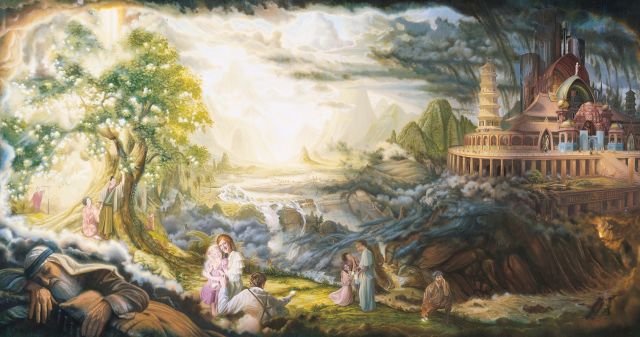
Lehi's vision of the Tree of Life by Steven Neal

He sees a tree in the distance with the most glorious fruit; fruit that is so delicious and satisfying that he describes it as highly desirable.  To get to the tree, you must grab hold of an iron rod to guide you along a narrow path. If you let go, there are mists of darkness where you will get lost and a dirty roiling river where you will drown if you fall in. Lehi, after he's tasted the fruit, wants all of his family to partake as well but his two rebellious oldest sons choose not to grab hold of the rod and follow the path to get to the tree.  Lehi also sees endless throngs of people pressing forward; some of them find the path, some wander off into darkness, some drown, and some reject the gift after they've sampled it.  There's even a 'great and spacious building' without a foundation where naysayers have gathered to scoff at those who are on the path to the tree or have made it and tasted but have doubts.

The account of his vision is full of symbolism that applies to being a believer in today's world of ridiculing unbelievers.  The fruit is God's love, the iron rod is the scriptures whose message guides us in our journey back to God, the mists and river are the temptations to do things we know we shouldn't...  But there's also a very individual message to every person who studies it.  We are all there as part of that endless throng.  And so it offers an invitation to reflect on just where you are in your journey.

If I'm honest, and I am, I've become way too casual in how I'm making my journey.  Along this path, I've stopped to sit on the rocks alongside it for a long rest.  And I've backtracked a few times to hang out with a different set of friends.  I've hooked my pinkie finger around the iron rod and leaned way out over the chasm of the filthy river just to see what it looked like.  Heck, I've probably spun round and round on it like a kid on monkey bars a few times.  My path looks nothing like what the words "strait and narrow" bring to mind... but more like one that weaves and winds wildly, grows faint in spots, and is blocked by huge boulders in other places.  This is a good time to reign that in and rest my soul in the simplicity of following a clearly marked path.

Gordon B. Hinckley once said, "To me, the gospel is not a great mass of theological jargon.  It is a simple and beautiful and logical thing, with one quiet truth following another in orderly sequence.  I do not fret over the mysteries.  I do not worry whether the heavenly gates swing or slide.  I am only concerned that they open."

That it's simple and beautiful and logical really resonates with me... it's a good description of the criteria I'm using to rebuild my life.

Thursday, April 6, 2017

The Rock Piles of Appalachia

One of the more charming aspects of living in Appalachia are the stories. When I first heard John Denver sing that "...life is old there" (Country Roads, 1971) it was a truth I didn't have the means to appreciate. Yet. I'm learning that now through the sights and sounds and tastes and endless stories.

Everything has a story here... even the rock piles.

Most often the ones I see have a logical and evident explanation. They've been chiseled and then dry stacked as fences, retaining walls, foundations, stairs, road surfaces and structures. The early American settlers were surely not strangers to hard physical work. Think what it took to heft some of those stones into place even using cantalever!

A partially collapsed retaining wall. These are holding back terraces
which demarcate property lines on the downward side of a hill in
Mount Savage, MD.  If only it were mine... I would love to restore
this charming feature!


The old springhouse on the same property.  Time and neglect and [effective
though historically insensitive] rennovations have left it ravaged almost
beyond repair but how I would like to try...


You might be wondering what a "springhouse" is. I'm going to call it a necessity of both early American life and for those seeking a self-sufficient lifestyle not so tied to today's utility grid. The most basic purpose of a springhouse is to cover a spring with a simple, usually just one room, structure to keep the water clean and potable. It keeps out fallen leaves and animals that could introduce infectious bacteria to the water source. The cold water and stone construction keep a springhouse cool year round so it also provides refrigeration to store foods like cured meats, fruit, vegetables, and dairy products safely away from predators.

And then sometimes you randomly find a huge pile of stacked rocks out in the middle of the forest.  It's neat and ordered and shows intelligent design in its construction. It just doesn't make sense in context of its location. At least not with how the locale is used today. And since Appalachia has been continually populated by uncounted cultures for thousands of years we are left to speculate about the purpose these rocks served and any meanings attributed to them in the distant past. Couple that with a landscape that holds onto the secrets of what may hide deep within its volcanic ancient history...

This example is near Spruceton NY. I found it in this 2008 blogpost from
Rock Piles. They refer to them as cairns, which to me suggests
a burial site.  Perhaps?  It makes for a good story!

And there you have mystery and intrigue... essential ingredients to any good story!

Were these stones laid by some of America's first inhabitants? Perhaps they are altars of worship like The Book of Mormon describes... or trail markers, or defense structures in an ancient war, or hunting blinds maybe? Along with the equally mysterious stone circles (like Scotland's Stonehenge and the smaller less well known circles here in Appalachia) are they evidence of an ancient alien presence? Are they just stones cleared from the fields of a farm that has been reclaimed by nature? The answer, and the story, depends on who you ask!

I would say many of the less easily explained rock piles come from preparing a field for planting crops. Stones were removed to make it possible for the farmer to work his field and produce a crop. They were stacked somewhere out of the way. Most of us who grew up on or around farms or in families that gardened are familiar with the process and have likely spent some time "pickin' rock."  That familiarity tugs at the heartstrings... These rocks remind us that there's something both comforting and disturbing about the temporary nature of our time on Earth. This is work that's as important as it is fleeting... What once served as a family's livelihood is reduced to nothing more than a few tons of stone... and a mystery for future generations to wonder about.

Sunday, May 10, 2015

The Power of the Word

As I've said now and then, I sometimes substitute for the regular teacher in Sunday School or Relief Society (the women's auxiliary of the LDS Church).  Today was one of my days to have a captive audience!  Lesson material was drawn from an April 1986 General Conference address by Ezra Taft Benson, his first Conference as President of the Church.  He was addressing the Priesthood session but the concepts hold value for all of us still today.

He noted, "We live in a day of great challenge.  We live in that time of which the Lord spoke when he said, "peace shall be taken from the earth, and the devil shall have power over his own dominion."  (D&C 1:35)  Those words were spoken 29 years ago.  Think about how much has changed in that time.  Both good and evil have grown stronger.  There's less "gray area."  President Benson continued, "...while many of our members are remaining faithful and strong, some are wavering.  Some are falling.  Some are fulfilling John's prophecy that in the war with Satan, some Saints would be overcome. (Rev. 13:7)

Besides John the Revelator, prophets such as Lehi and the Apostle Paul spoke about this same condition in our days.

Learn more about this picture and the artist, Dr. Steven L. Neal, here:
http://nealmd.com/paintings/2681359
Lehi saw that many people would wander blindly in the mists of darkness, which symbolized the temptations of the devil.  He saw some fall away "in forbidden paths," others drown in the rivers of filthiness, and still others wander in "strange roads," (1 Nephi 12:17 and 8:28,32)  Paul described a time when such things as blasphemy, dishonesty, cruelty, unnatural affection, pride and pleasure seeking would abound. (2 Tim. 3:1-7)  Such grim predictions by prophets of old would be cause for great fear and discouragement if those same prophets had not, at the same time, offered the solution.  In their inspired counsel we can find the answer to the spiritual crises of our age.  Lehi wrote of an iron rod and when his older sons, Laman and Lemuel, asked what it meant, the answer was "It was the word of God; and whoso would hearken unto the word of God, and would hold fast unto it, they would never perish; neither could the temptations and the fiery darts of the adversary overpower them unto blindness, to lead them away to destruction."  (1 Nephi 15:23-24)  Not only will the word of God lead us to the fruit which is desirable above all others, but in the word of God and through it we can find the power to resist temptation, the power to thwart the work of Satan and his emissaries.

Several weeks ago when Katelyn McLeod spoke in Sacrament Meeting she said, "Conversion is a choice you make every day not something you get to decide once and then move along with your life."  At the time I saw it as a great comfort and contrast to a troubling sentence that had stuck with me from a blog post I'd read sometime earlier.  That blog, and I've forgotten both the author's and blog's name now, was written by an active LDS woman and in that particular post she was talking about current church events and some sadly high profile excommunications.  Overall the post was well done and positive, except the last sentence... She said that "leaving the Church was not beyond the realm of possibility in [her] future."  That bothered me.  And it made me sad.  It also caused me to reflect on my own commitment to the gospel and what I'm doing about keeping it strong. I resolved to focus more on the basics: church attendance, prayer and scripture study.

Spending quality time in the scriptures is the answer to the great challenge of our time.  The word of God, as found in the scriptures, in the words of living prophets, and in personal revelation, has the power to fortify the Saints and arm them with the Spirit so they can resist evil, hold fast to the good, and find joy in this life.

Photo from lds.org
President Benson referred to an earlier meeting giving instruction to Stake Presidents and Regional Representatives in 1982. At that meeting, Boyd K. Packer said "Buildings and budgets, and reports and programs and procedures are very important.  But, by themselves, they do not carry that essential spiritual nourishment and will not accomplish what the Lord has given us to do.  The right things, those with true spiritual nourishment, are centered in the scriptures."  And it's true, none of those activities can be ignored and laid aside, but they are not the most important thing you can do.  In recent years, time and again we have counseled you that certain activities bring greater spiritual returns than others.  As early as 1970, President Harold B. Lee told the Regional Representatives: "We are convinced that our members are hungry for the gospel, undiluted, with its abundant truths and insights.  There are those who have seemed to forget that the most powerful weapons the Lord has given us against all that is evil are His own declarations, the plain simple doctrines of salvation as found in the scriptures."

Each of us must, at some point in our lives, discover the scriptures for ourselves -- and not just discover them once, but rediscover them again and again.  We filter what we are reading by the sum of our experiences and since we are living and experiencing every day, each time we read a scripture we have the potential to see it in a new way because we now understand differently.  "The Lord is not trifling with us when he gives us these things, for 'unto whomsoever much is given, of him shall much be required. (Luke 12:48)  Access to these things means responsibility for them. We must study the scriptures according to the Lord's commandment and we must them govern our lives. (3 Nephi 23:1-5)

During our last Stake Conference, Elder Kopischke spent a great deal of time talking about how Councils work.  He was specifically talking about Ward Councils but noted that the principals apply to Stake Councils, General Councils and even Family Councils.  He instructed our leadership to consider what is the best for an individual over what is in the interests of the auxiliary organizations of the Church.  When we care for the people, the auxiliary needs will be better met than when we put them first.  That same idea also applies to us as individuals.

If YOU do this:                                                  The whole Ward benefits with:
Immerse yourself in the scriptures                     Increased activity levels
Search them diligently                                       Testimonies will increase
Feast on the words of Christ                              Commitment will be strengthened
Learn the doctrine                                              Families will be fortified
Master the principles                                         Personal revelation will flow

Bend your efforts and your activities to stimulating meaningful scripture study!

The Prophet Joseph Smith said that "the Book of Mormon was the most correct of any book on earth, and they keystone of our religion, and a man would get nearer to God by abiding by its precepts, than by any other book."  (Book of Mormon, Introduction)  To get nearer to God... Isn't that what we all want?

We want it individually and collectively.

In the Joseph Smith Translation of Matthew, during the Savior's great discourse on the Mount of Olives, He promises "And whoso treasureth up my word, shall not be deceived."  (JST Matthew 1:37)  Sisters, when we pick up the scriptures we hold a treasure in our hands.  Do we treat them as a treasure?  They are filled with guidance for our lives...

"Thy word is a lamp unto my feet, and a light unto my path."  (Psalms 119:105)

Nephi promises that feasting upon the words of Christ "will tell you all things what ye should do."  (2 Nephi 32:3)

They are also there to pull us back when we go astray.

"Yea, we see that whosoever will may lay hold upon the word of God, which is quick and powerful, which shall divide asunder all the cunning and the snares and the wiles of the devil."  (Helaman 3:29)

Success in righteousness, the power to avoid deception and resist temptation, guidance in our daily lives, healing of the soul -- these are but a few of the promises the Lord has given to those who will come to His word.  The word of the Lord is a valuable gift, and we must not treat it lightly... but treasure it.  Spend time in the scriptures.  Learn to hear God's voice for yourself.  Immerse yourself in a relationship with Him.

What a treasure!

"For where your treasure is, there will your heart be also."  (Matthew 6:21)
Monday, February 13, 2012

What's in a Name?

Today at Church a new baby was blessed and presented to the congregation.  In the LDS faith, the blessing ordinance follows a loose pattern and often very similar wording at the beginning.  Part of that formal verbiage is "to give a name and a blessing."  It allows the baby's father to express the wishes and comforts the child will need to grow successfully as it helps all of us know how to support and identify this new little person.

Names, like all words, have meaning.  For example, my given name is Kathryn.  Most of my life I've thought it was an old English name meaning pure.  But thinkbabynames.com says it's a variant of the Greek name Katherine and means pure.  Either way, I guess, pure is good.  My Mom used to tell me that she wanted to name me Kathryn Louise but my Dad said no.  His opinion was that "girls just go off and get married and a middle name just makes it too long."  For a long time I was kind of grateful... the thought of having Louise as a middle name when I was 12 or so was kind of horrifying!  I mean, that's like a grandma name.  Funny.  It doesn't sound quite so terrible these days.

As Church services progressed and we moved into our Sunday School class, the topic today dealt with names and blessings.  The lesson material was drawn from 2 Nephi, chapters 3-5.  Here, I'm only going to touch on a few verses.  At this point, an elderly Lehi takes each of his children aside to give them a final father's blessing.  Chapter 3 is the blessing of his youngest son, Joseph, and while he elaborates on many points throughout the rest of the chapter, I want to focus on verses 3-5 where he explains just who Joseph is, their family lineage and blessings to come to his posterity.  Specifically, he points out:

  • Joseph is his last born... the youngest child in the family, born in the wilderness after their family left Jerusalem.
  • Joseph's seed, or posterity, will not be utterly destroyed but will survive to continue their family line.  Not all of his sons received this promise... they were told that their future generations would dwindle in disbelief and die.
  • Lehi reconfirms that Joseph is his child, the "fruit of my loins."  I think at some point every child needs this reassurance of belonging in their family.  In effect, what their name is.
  • Their genealogy can be traced back directly to Joseph who was carried away to Egypt.  And he likely is the namesake for this Joseph.
  • They are the "broken branch" and still entitled to all the blessings promised to the house of Israel in the latter days.

For a young man whose entire life had been that of a poor nomad, this must have been wondrous information and an intensely spiritual bonding experience with his dying father.  I can only imagine that it would make quite the impression on me anyway.  How would you feel walking in his shoes?

Sunday, January 29, 2012

Cliche or Overlooked Gem?

I, Nephi, having been born of goodly parents, therefore I was taught somewhat in all the learning of my father, and having seen many afflictions in the course of my days, nevertheless, having been highly favored of the Lord in all my days; yea, having had a great knowledge of the goodness and mysteries of God, therefore I make a record of my proceedings in my days.

This is 1 Nephi 1:1.  As the opening verse to The Book of Mormon:  Another Testament of Jesus Christ, these words are often (and probably truthfully) called the most read words of all LDS Scripture.  They are so well known that probably a good half of all members of The Church of Jesus Christ of Latter-day Saints could recite them from memory.  And as such they've become almost a cliche rushed over by well-meaning Sunday School teachers eager to dig into the meatier parts of the text.  That makes me sad because it is such a great introduction to what the Gospel is and how to truly live it.

Let's break this verse of Scripture into 5 key phrases and touch on the richness of the ideas they present to us.

Born of Goodly Parents

This phrase harkens to the great commandment to love thy Father and thy Mother.  It talks of respect within the core family unit and the duty of children to their parents.  With it Nephi is telling us much about the character of the people who led his family.  He speaks to the righteousness and loving concern of his father, Lehi, and the unwavering support of his mother, Sariah.  I think it's significant that he calls them goodly.  Other scriptures show us the importance of making a good name for ourselves.  Proverbs 22:1 says, "A good name is rather to be chosen than great riches, and loving favour rather than silver and gold."  And Ecclesiastes 7:1 begins "A good name is better than precious ointment..."

Taught Somewhat in All the Learning of my Father

To me this underscores the importance of education, of always seeking to learn and apply new things to make our lives better.  It also reminds us that it's a parents' responsibility to teach the children in the home... to lovingly help their kids grow up to be responsible and contributing members of society and to seek out their own testimony of God.   I think Mosiah 1: 2 points this out so very well as King Benjamin taught his sons.  "And it came to pass that he had three sons; and he called their names Mosiah, and Helorum, and Helaman. And he caused that they should be taught in all the language of his fathers, that thereby they might become men of understanding; and that they might know concerning the prophecies which had been spoken by the mouths of their fathers, which were delivered them by the hand of the Lord."  The family is central to all LDS Church teachings and beliefs.  A modern prophet, David O. McKay, taught "No success, however great, will compensate for failure in the home."

Having Seen Many Afflictions/Been Highly Favored of the Lord

So often we see these conditions as being exclusive... that being favored by the Lord means being free from affliction.  Nephi shows us that's simply not true; that affliction and blessing can co-exist in one's life.  Looking ahead in the text to 2 Nephi 4:18-25 gives a synoptic glimpse of what he meant by experiencing many afflictions while being highly favored.  Alma 27 tells of another, later, people who were also greatly afflicted and greatly favored at the same time.  Notice especially the mirroring of these words in verses 29 and 30.

Knowledge of the Goodness and Mysteries of God

How many times in bearing testimony of the Gospel does a person begin by expressing gratitude for the many things God has graciously given them?  This is their knowledge of God's goodness.  As they go on to explain that the Spirit has borne witness to them regarding a particular precept, they are telling what they know of the mysteries of God.  With this phrase, I believe Nephi is telling us that he has a testimony... that he knows God lives, that He is aware of, and interested in, us as individuals and that He is eager to bless us as we conform our wills to match His.  We would do well to follow Nephi's example and seek to know within ourselves the goodness and mysteries of God and then to share that knowledge fearlessly.

A Record of  my Proceedings in my Days

Mankind has an innate need to leave behind a record; something to prove that we were here and we mattered.  I think that springs from the notion that a Book of Life is kept in Heaven and our thoughts and deeds in mortality are recorded there for our ultimate judgement.  2 Nephi 4:15-16 tells us that Nephi knew his purpose in keeping his record.  It says, "And upon these I write things of my soul and many of the scriptures which are engraven upon the plates of brass.  For my soul delighteth in the scriptures, and my heart pondereth them and writeth them for the learning and the profit of my children.  Behold, my soul delighteth in the things of the Lord; and my heart pondereth continually upon the things which I have seen and heard."  To this day, members of the LDS Church are a record-keeping people.  We seek out documentation on our ancestors; we write in journals; there are detailed notes of our meetings... and because we believe in an open canon, new scriptures are constantly added to our standard works.

I think Nephi, with his kind of rambling opening sentence, provides a great overview to the entire gospel message.  It deserves more credit and attention that it seems to get.